
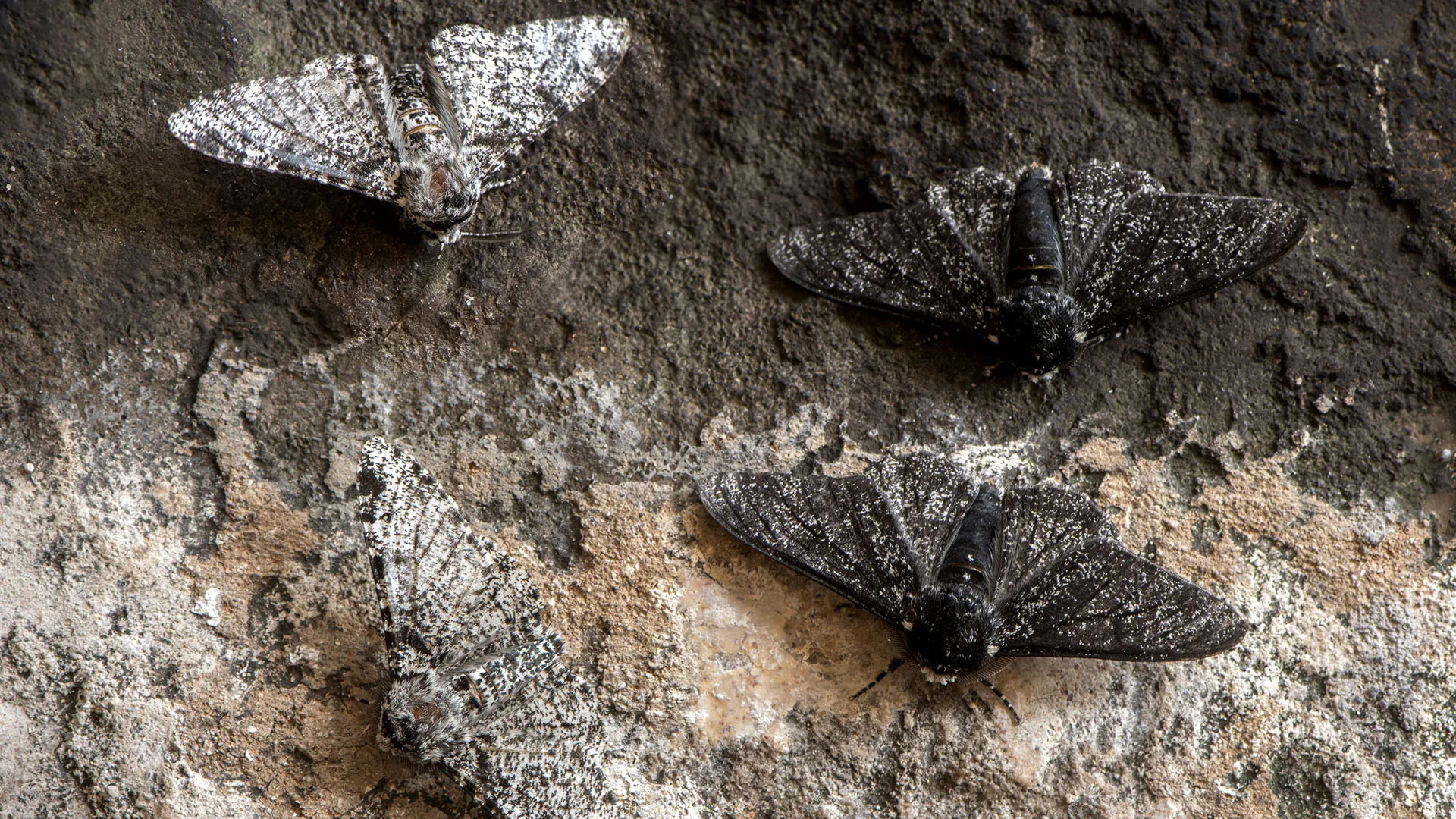
In the land of Great Britain, there is a small, beautiful insect. It flies around in gardens, parks, and even woodlands. Despite being a common insect, it has an interesting story.
Meet the Peppered Moth
The peppered moth is a common type of moth that can be found all over Britain. Peppered moths are usually covered in black and white speckles, that is why they are called “peppered”. Because of this look, they are able to camouflage with lichen on trees. The camouflage protects them from robins, swallows, and other types of birds. These insects also protect themselves by being nocturnal and staying hidden during the day. There are also black peppered moths. Black peppered moths were created because of a spontaneous genetic mutation. The first ever black peppered moth was recorded in Manchester, England in 1948.
These insects don’t blend in that much with the lichen, so they were easily spotted by predators, and because of this, fewer black peppered moths survive and breed. This process of survival where a species is better adapted to its environment and survives and has more offspring is known as “Natural Selection”. Charles Darwin and Alfred Russell Wallace outlined this process by their evolutionary theories. We are gonna talk about these guys and their theory of evolution in the next paragraph!
We have Charles Darwin. He is a British naturalist who set sail on an expedition that lasted half a decade to study animals in the tropics. He spent five weeks in the Galapagos Islands, an archipelago near Ecuador, South America. There he classified many different species, he even discovered a wide variety of characteristics between the animals he studied on the islands.
For example, the tortoises on Pinta Island have shells that rise at the front, whereas the ones on Isabela Island have dome-shaped shells. This was because of the environment that the tortoises were in. Like on Pinta Island, tortoises eat tree cactuses and they have to lift their heads. In comparison, on Isabela Island, tortoises eat plants on the ground; they didn’t need to lift their heads.
Another British naturalist was Alfred Russell Wallace. He wrote a letter to Charles Darwin that described how his studies and research supported Darwin’s discoveries. Both of their theories were published. The peppered moth supported their evolutionary theories, even if neither of them discovered it. They were able to tell this because there were more light peppered moths than black ones.
During the industrial revolution, air pollution from coal fires and factories darkened trees and walls, making it harder for speckled moths to hide. The 98% of Black moths that were totally black blended in better with the soot, avoiding predators and reproducing more. By the late 19th century, nearly all peppered moths were black, while the speckled ones became rare.
Then in 1952, scientist Dr. Henry Bernard Kettlewell did experiments to discover if natural selection had actually caused the increment of the black peppered moth population.
He went all over the country just to gather up some data, so he could map the speckled and black peppered moths. He studied his data and he found out that there were fewer black ones in rural areas because there was less pollution and there was no soot, compared to cities where there are a lot of black ones.
He also did some field studies. He found both speckled and black peppered moths on trees in both polluted and clean places. He observed to see how long it took for birds to spot the two species in these different places. He found out that it took twice as long for birds to find black peppered moths in polluted areas on a tree with soot than lighter peppered moths, compared to in clean environments where black ones were spotted more easily than the lighter ones because trees had lichen. He said that a peppered moth has a higher chance of surviving if it can camouflage in the environment, and this supported Wallace’s and Darwin’s theories of natural selection.
The Evolutionary Process
It started in the mid-20th century. There was air pollution everywhere, so the government made some laws. Because of this, the air got purified and became fresh and clean. Lichen grew on trees again and soot disappeared. The speckled peppered moths can camouflage, but the black ones became vulnerable. The speckled ones became common again. This process of evolution shows how natural selection is bilateral and always favors the type of peppered moth that fits the environment.
The peppered moth became a symbol of hope that other species can also survive by adapting to the changes in the environment caused by humans.
And that is the story of the peppered moth! I hope that you liked this story as much as I did!
About the Author:

Hi, my name’s David Casian D. Ambat. I’m from the Philippines. My hobby is drawing characters from games like Five Nights at Freddy’s, Sprunki, Roblox, etc. Besides that, I also like reading books. I’ve read lots of different kinds of books, which helps me learn new words and their meanings. That’s not all; I also like making things, especially out of cardboard and paper. I have a collection of different kinds of paper things like origami, airplanes, puppets, and more. I also like talking about space because I like astronomy. I want to become an astronomer. I hope that you enjoy the things I post. Thank you!